Good habitat takes a team on the same page
Providing habitat for lesser prairie-chicken works best when landowners have an incentive, according to members of the Lesser Prairie-Chicken Landowner Alliance.
The recently announced alliance is designed to work with ranchers, rural communities and preserve wildlife in the southwestern Great Plains.
The alliance stated landowner-conservationists are pursuing an innovative and inclusive new path to successfully raise livestock while also providing critical contributions for conservation outcomes. They seek to be paid fair market value for conservation services, including healthy soils and vegetation, clean air and water, carbon storage, and healthy wildlife, allowing operators to produce food and fiber.
Wayne Walker, principal of Common Ground Capital, near San Angelo, Texas, said it is an opportunity for landowners to receive an additional revenue stream. He said there is added benefit for landowners who are good stewards, and their work in certain locations can also benefit lesser prairie-chicken habitats.
“By paying market rate we can keep livestock production going and help kids to stay on the ranch,” Walker said.
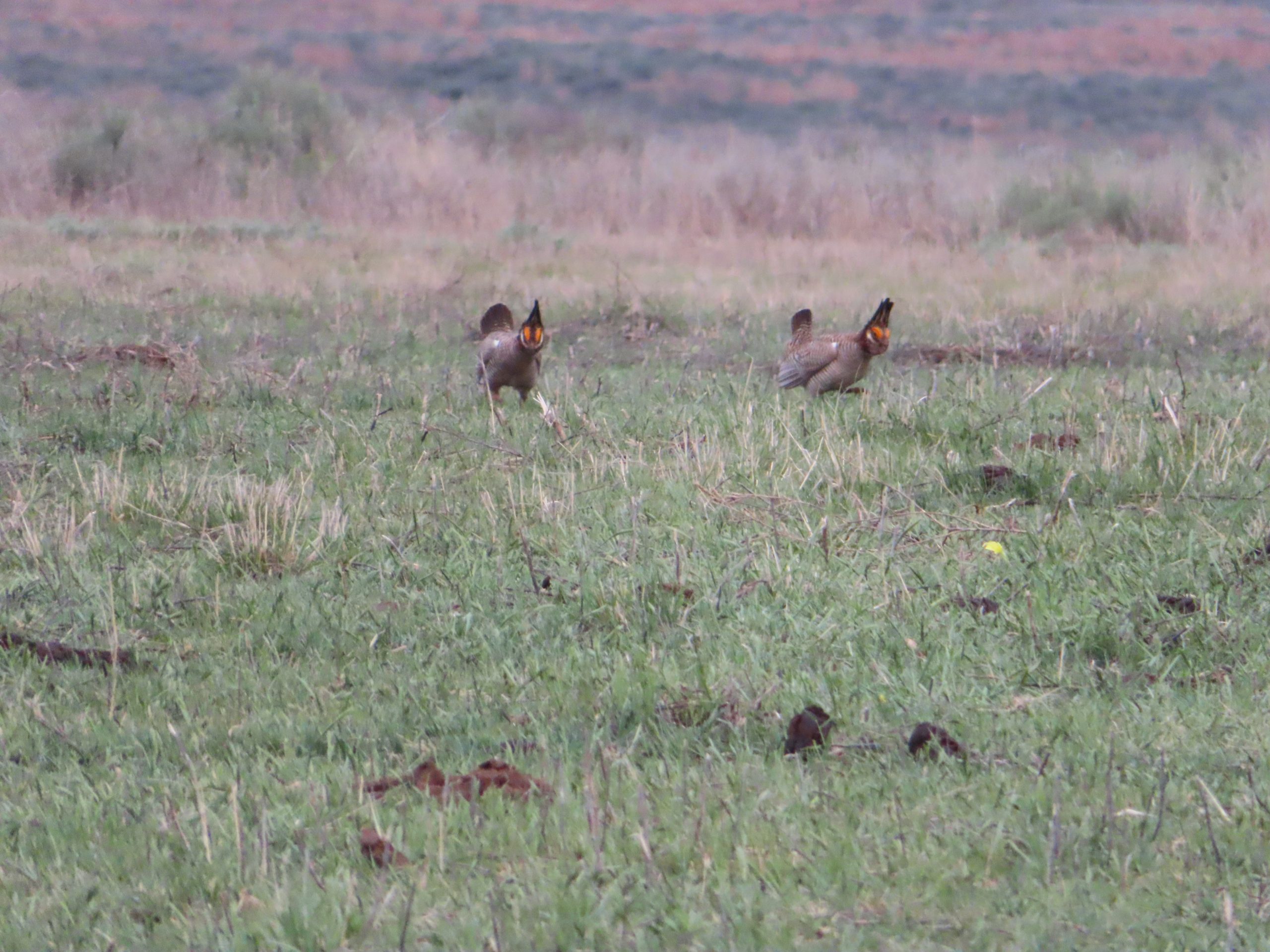
Pictured above are lesser prairie-chickens during a lek in April on the Gardiner Angus Ranch, Ashland, Kansas. (Photo courtesy of Michael Smith.)
Ted Koch, executive director for the North American Grouse Partnership who retired as an endangered species biologist with the U.S. Fish and Wildlife Service, is helping the alliance. Koch ran the U.S. Fish and Wildlife Service’s lesser prairie-chicken biology program for 35 years. He noted in a video that the best stronghold for the lesser prairie-chickens is on private land where ranching interests are strong. Koch and alliance members spoke at the Henry and Nan Gardiner Marketing Center in Ashland, Kansas.
Walker said the stronghold associated in the area southwest of Ashland near the Oklahoma border has seen an estimated increase in bird count.
“By no means are we claiming this is going to save the lesser prairie-chicken,” Walker said.
What he and landowners have observed is that with fairly consistent weather, timely rains and habitat improvements, bird numbers can increase. “We’ve got a program in place that’s working and it just needs time to grow.”
The past 15 years have taught Walker about outside influences. One unifying theme was that working together with long-term incentives for ranchers is important. Whether the incentives come from private credits, the Conservation Reserve Program, other programs, or a combination, the good news can benefit ranchers and lesser prairie-chickens.
In a news release, the alliance noted the need for rangelands to boost livestock production that in turn benefits rural communities.
LPCLA’s mission, to ensure the perpetual success of ranchers, rural communities and preserve water and wildlife throughout the Great Plains and beyond, requires a mindset of recognizing the past while envisioning a future together.
Conserving water in the Ogallala Aquifer is important, Koch said. Healthy rangelands store up to 66% more water than bare ground and preserving habitat for the bird also conserves water.
Alliance member Mark Gardiner, Ashland, said using grasslands to feed cattle makes economic sense. “The key is to have a healthy ecosystem and to have that healthy ecosystem is no different than our rural community. Prairie chickens are important, but people are too,” Gardiner said. “The way people survive in this rural community where we are today is having a ruminant animal that can take these grasslands and convert it into food for the world, and they do it so very efficiently. So, when all those things coexist and work together, we all get better.”
Gardiner said his family’s approach is to stay with a process that works. “We’re still using the principles taught by K-State and Henry Gardiner that rotational grazing is good for the ecosystem, which is good for cattle and good for the prairie chicken.”
Gardiner says it is important for landowners to be deliberate in their approach and ask many questions if they are considering joining any habitat program that requires a long-term commitment.
Gardiner has a good working relationship with Walker who knows that ranchers need the pastures and rangelands to support cattle. In Gardiner’s case, the agreement needed flexibility.
“Here it’s going to be for cattle,” Gardiner said. “I’m not going to give up my independence unless it is a good business decision for our family.”
Koch said, the lesser prairie-chickens will be fine as long as ranchers stay in business and that’s the approach of the North American Grouse Partnership.
“We as Americans, appropriate tens of billions of dollars a year for conservation, but we don’t ask these professional businesspeople, what does it take? What does it take to stop losing 2 million acres a year? What does it take to save an endangered species? We should be asking them that question and following their lead,” he said.
That approach works better than offering government programs, then having restrictions that impede their way to making a living.”
Bret Riley, an alliance member from Sand Ranch, New Mexico, said, “Our goal with this group is to provide pathway for producers, like ourselves, to maximize the ecological health on our properties. And we feel like if we could do that, it takes care of our production agriculture as much as it does the wildlife that benefit from it.”
Walker said the state of Kansas has recognized the effort to conserve the habitat, enhance livestock production, promote rural communities and preserve water resources.
For more information about the alliance, visit www.grousepartners.org/lpcla.
Dave Bergmeier can be reached at 620-227-1822 or [email protected].